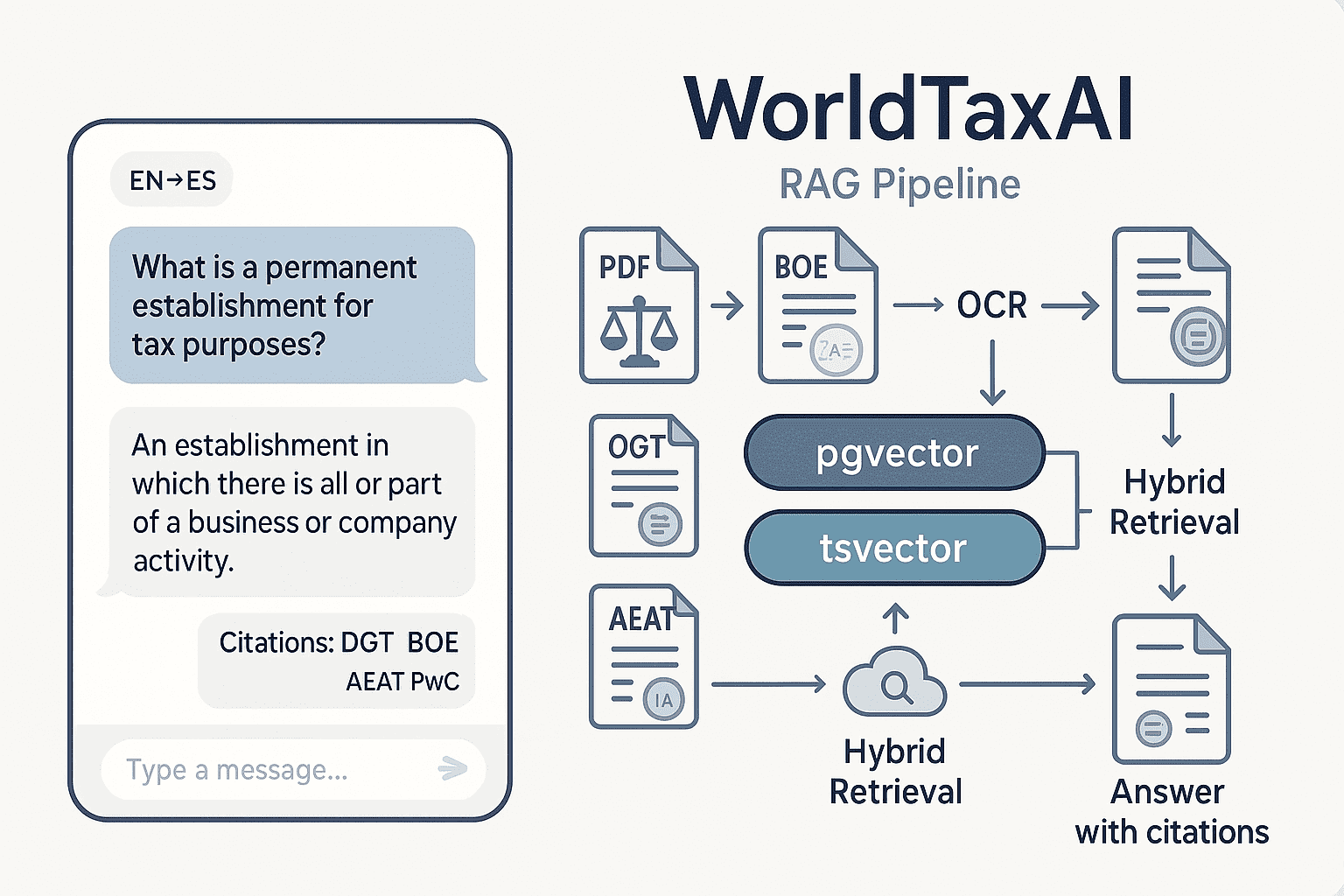
WorldTaxAI – Chatbot fiscal (Espagne) avec RAG & recherche hybride
WorldTaxAI
8 weeks
6 600 euros
““WorldTaxAI lets us query tens of thousands of Spanish tax documents with reliable, cited answers. Concept search works very well, and the team is responsive to adjustments.” — WorldTax Team”
— WorldTaxAI
Project summary
WorldTaxAI is a multilingual (EN↔ES) tax chatbot dedicated to Spanish tax law and administration. It uses a robust RAG that combines semantic search (pgvector) with lexical search (tsvector) to deliver fast, reliable, cited answers.
- Corpus: ~60,000 documents (BOE, DGT, AEAT, PwC), unified from heterogeneous PDFs.
- Quality: OCR, cleaning, Unicode normalization, 400–600 token chunking.
- Indexing: PostgreSQL + pgvector (HNSW) + FTS tsvector (GIN).
- App: FastAPI backend, React/Next front-end (streaming), chat history & deletion.
- Multilingual: questions in English, cited results from an ES-heavy corpus.
Objectives
- Fast access to regulations, rulings, notices, commentary.
- Reliable, cited answers (passages + page/section deep-links).
- Multilingual EN↔ES (terminology robust).
- Cost control (low-cost embeddings, unified Postgres infra).
- Chat features: history, resume, delete, export.
Why hybrid search?
- Semantic (embeddings): captures conceptual proximity; robust to multilingual queries (EN↔ES) and paraphrases.
- Lexical (tsvector): anchors exact references (e.g., modelo 190, art. 10, acronyms).
- Score fusion (+ domain boosts, MMR): maximizes recall & precision without hard filters, aligned to legal intent.
Architecture & pipeline
1) Ingestion & OCR
- Text extraction from born-digital PDFs & scans (OCR).
- Language detection, Unicode normalization, removal of headers/footers, page numbers.
2) Structuring & chunking
- 400–600 token segments with section path and page numbers.
- Quality checks, deduplication, timestamps.
3) Document enrichment
- Metadata: jurisdiction, document_type, doc_title, source_name, year.
- Topics: primary_topic (closed list), secondary_topics (3–5 controlled tags).
- Short abstract for previews + optional doc-level embedding.
4) Embeddings & index
- Model: text-embedding-3-small (OpenAI).
- Storage: PostgreSQL + pgvector vector(1536) + HNSW index.
- Parallel lexical search via tsvector + GIN index.
5) Hybrid retrieval & ranking
- Vector EN↔ES + exact-match lexical.
- Normalized score fusion, domain boosts by topics/type, MMR for diversity, light re-rank.
- Select 5–8 passages with citations (title, section, page).
6) API & Front-end
- FastAPI: auth, sessions, pagination, purge.
- React/Next (streaming): i18n, copy cited snippets, export conversations.
- Speech-to-text endpoint (optional).
7) Ops & security
- CI/CD, metrics (latency, tokens, Recall@k), budgets.
- Privacy: API data not used to train ChatGPT; optional zero retention.
- RLS/read-only permissions, minimal logs, per-segment traceability.
User experience
- Per-user history: resume, rename, delete.
- Clickable citations to the source (with context).
- Fact-based answers: the model does not invent, it grounds in retrieved snippets.
- Multilingual: ask in EN, results in ES, optional EN summary.
- Streaming answers; voice input (optional).
Results & impact
- Seconds to access previously scattered content.
- High recall on technical queries (retención dividendos — modelo 190, establecimiento permanente, etc.).
- Significant time savings for analysts & attorneys.
- Ready foundation for monitoring & analytics (trends, clustering, dedup detection).
Tech stack
- Backend: Python, FastAPI, SQLAlchemy.
- Database: PostgreSQL, pgvector, tsvector, Docker.
- LLM & embeddings: OpenAI (chat gpt-4o-mini, embeddings text-embedding-3-small).
- Front-end: React/Next, streaming, i18n.
- Ops: CI/CD, monitoring, budgets.
Timeline & budget
- Phase 1 — scraping & preparation: delivered, ~2–3 weeks.
- Phase 2 — RAG + API + front + deployment: ~4 weeks.
- Phase 2 quote: €6,600 excl. VAT (21 days @ €300/day).
- Recurring API costs: low (one-shot indexing, lightweight queries).
CTA: Want a POC on your corpus (EN/ES) or an extension to your internal portal? Get a demo.
Client testimonial
“WorldTaxAI lets us query tens of thousands of Spanish tax documents with cited, trustworthy answers. Concept-based search works well, and the team is responsive to adjustments.”
— WorldTax Team
FAQ
Does the chatbot “learn” from our data?
No. API data is not used to train ChatGPT. Embeddings and texts remain private.
Can I ask in English if the corpus is in Spanish?
Yes. Multilingual embeddings + bilingual FTS (language routing).
How do you ensure quality?
Cited answers; continuous evaluation (Recall@k, Precision@k, Faithfulness).
How does it scale?
pgvector handles hundreds of thousands of vectors. HNSW/IVF indexes for speed. Stateless API.
Security & compliance?
Private PostgreSQL, read-only permissions (RLS), history deletion, auditable CI/CD, minimal logs.
Resources & next steps
Sample technical queries
- “Retención sobre dividendos no residentes — modelo 190 (EN→ES)”
- “DGT criteria on digital permanent establishment (EN→ES)”
- “Double tax relief exemption art. 10 — BOE 202x (ES)”
Product extension ideas
- Stronger re-ranking (cross-encoder), query rewriting (expansion).
- Quality dashboard (coverage, freshness, terminology drift).
- Monitoring: incremental ingestion (BOE/DGT/AEAT webhooks), topic alerts.

datamonkeyz
Need the same pipeline?
Reach out, we answer fast.
Replies in under 1 hour
Need this for your team?
We reply fast and can scope a call right away.